I never thought I'd get this paper out of the recesses of my computer. Thanks to Dr. Larry Heaney, whose encouragement never wavered, please find the link below to our paper "Survival of a native mammalian carnivore, the leopard cat Prionailurus bengalensis Kerr, 1792 (Carnivora: Felidae), in
an agricultural landscape on an oceanic Philippine island".
http://threatenedtaxa.org/ZooPrintJournal/2013/June/o335226vi134451-4460.pdf

Monday, August 5, 2013

Friday, May 20, 2011
Safety first +
The streets were empty. Not one kid can be seen playing on the streets. Then I heard their voices. They were playing inside a building being used as a chapel on Sundays. I was on my way to Transect 5.
My eyes scoured the ground. I was acutely aware of someone following me. I tried not to let this bother me. For ten months, we’ve been doing our transects alone; Jeric and I in separate transects, sometimes, not even meeting each other on our way to our next transect for the day. Now, I had to have someone walk with me. And Jeric has his walking buddy.
One would think that conducting fieldwork in a farm relatively close to the big city will not present dangers. Wrong. We’ve had our share of threats to safety as well. Never mind the usual fieldwork safety issues. The one we’re dealing with now is almost unheard of, at least when someone tries to study an animal in the ‘wild’.
About a week ago, we received news that some children have been kidnapped for organ harvest. We never really believed it until one Saturday morning, a niece of one of the farm staff was found dead next to a culvert in Brgy. San Miguel, the barangay next to Ara-al going down to La Carlota. They have gauged out her eyes, and taken her kidneys. The kidnappers, whoever they are, left PhP30,000 ($695 US). Was it supposed to pay to her parents’ grief over the loss of their child, so brutally murdered? The local police won’t move, apparently because no one has filed a complaint. Meanwhile, two unidentified vans with heavily tinted windows went inside the hacienda by way of the main road a few days ago.
Parents are terrified. So are we. But I am not calling off fieldwork, so I resorted to having us walk with someone during our transects. Safety first. +
Friday, May 13, 2011
Yo ho ho and a bottle of rum...

Jeric, who speaks better Hiligaynon (the local language), went ahead with the questions—the negotiations will follow suit. The men were detrashing the cane (i.e. taking out the dried cane leaves from the stalk) when the ‘nest’ was discovered by someone’s dog. The dog gave the adult maral a chase, apparently killed it, and one of the men took the kittens and the carcass home with him about an hour before we came. The fur was seared with fire—the mother maral will go on someone’s dinner plate tonight.
 He didn’t want to give up the kittens for donation. He said he’s saving them for a certain rich person in Bacolod City, who bought a couple of kittens from him last year for PhP1500 apiece (~$35 US). We never paid for any of the kittens we rescued before. We didn’t want to give anyone the wrong idea, so we chose to give the captor/donor a packet of cigarettes for their trouble, and our eternal gratitude. In my broken Hiligaynon, I negotiated with Jeric. We were hoping that they’ll take pity on the tiny kittens, which will surely die with them. We could feel that they were about to give in, and Jeric was going to ‘sacrifice’ his unopened pack of cigarettes, when nong Aying interfered with, “Day, maybe you should give them a bit to buy rum.” Jeric gave me a look that said, “We were so close…” I nodded so he handed them a hundred-peso bill which we had to borrow from nong Aying—neither of us had money on us.
I took the kittens home in, ironically, a used box of rum.
Thursday, May 5, 2011
Noah's Ark was too small...
 Biblical scholars say that Noah's Ark measured about 300 cubits long, 50 cubits wide, and 30 cubits high. We can argue about which cubit to use but let's say Noah used the Roman cubit which is about 0.4445 m. That translates to an ark that measures 133.2 x 22.2 x 13.32 cubic meters. Athanasius Kircher, a German Jesuit who published Arca Noe in Tres Libros Digesta in 1675, said that the ark only has 150 kinds of birds, and roughly the same number of animals from the other vertebrate groups. This of course, did not include the fishes since they don't need a boat, or those that arose from spontaneous generation. During the 17th century then, the animals did fit snugly in Noah's Ark, not to mention his grinding mills.
By the end of the 17th century however, 500 species of birds, 150 species of quadrupeds, and roughly 10,000 species of invertebrates were recognized by science. By then, the ark is overcrowded. Now, we know that there about 5,498 species of mammals, 10,027 birds, 9,084 reptiles and 6,638 amphibians (Hoffman et al., 2010). You can tell me to exclude the marine mammals and the birds that spend most of their lives in open ocean but they still won't fit in Noah's Ark, however he calibrated his cubits. Especially if they came in pairs. Even if there were only a pair of rice-field rats in there.
Linnaeus solved this problem by saying that the Ark should be interpreted symbolically, rather than literally. He who has described, named, and catalogued about 6,000 species would know that biological reality does not reconcile with the Biblical story.
Taken literally, or metaphorically, with the way we're consuming our resources, perhaps given a few years, life on Earth will fit again in Noah's Ark.
Tuesday, May 3, 2011
Prison break
 I was cleaning up my hard drive when I came across this photo. I realized I had neglected one blog from October last year about one of our beloved baits, and so allow me to dedicate this to her; may she rest in peace...
She was inappetent and weak for a few days—Geri (as in short for Geronima), one of our lab rats, barely touched her food, and refused to budge even when gently poked. We were worried enough to close the trap, and take her home with us where we hope she’ll recover. Hopefully nothing that some TLC won’t cure.
But now she seems to be well. Well enough to attempt to escape the trap where we’ve put her temporarily as she recovers. I put her out on the grass, thinking that the sun would be good for her. I watched her as she tries, in vain, to bite the mesh. She would try and dig through the soil through the wire mesh, again, in vain. She would make some somersaults of sorts, although I cannot understand how, for the life of me, this will help her escape. I offered her some food. I didn’t dare put my hand close to anywhere she can reach with her teeth, no sir. She grabbed at it with her hands and teeth, like she wasn’t fed earlier. We shared that moment, human and rat. One trying to figure out how the other is; what it’s like to be the other being; what goes on in its brain, and thinking, "We're going to put you back out there again. Get me a maral, ok?" The other, just trying to get some food and taking the chance for an escape to the free world. Sometimes, life should be simple.
In memoriam.
Sunday, May 1, 2011
Crappy science-- literally!
 My apologies for using the word; I do not intend to cuss. But please read on, for there is a lot we can learn from sh*t.
Alright, let’s be a bit more scientific. We’ve been collecting leopard cat scats (poop, sh*t, crap… call it what you want) for the last 10 months we’ve been here on field. So far, we have 50-something scats stored in 95% ethanol in little plastic bottles (plastic vials with stopper are rare and expensive here). I wasn’t intending to study diet at all, but given our failure to trap leopard cats, might as well use them in my thesis.
So about a couple of weeks ago, I started doing my analysis on our samples. I tell you, after this, I will always associate the smell of ethanol with leopard cat scat! It’s quite a strong smell, but once you get over the odor, you get into the groove of scatology (i.e. the study of poop).
Ella Fitzgerald, Bach, Kimya Dawson, Carlos Vives, Parokya ni Edgar, The Corrs, John Prine, Greenday, and everything else in between keeps me company during my literally shitty moments. My ‘laboratory’ consists of a 1.7 mm sieve on a makeshift bamboo frame, a couple of pointy barbecue sticks, a pair of forceps, hot water in a plastic pail with a plastic tabo (dipper), a piece of cardboard I ripped off a box which I use to sit on, and a magnifying glass, which is perhaps the most sophisticated piece of equipment in the list. I would hunch over my sieve, wearing a mask over my face (no, it doesn’t help with the smell) and a pair of surgical gloves, picking through the soil, hair, bones, and everything else that makes up a leopard cat scat. I would take the tiny bone fragments, wash them carefully, and store them in small brown paper bags, properly labeled. I will be bringing these specimens with me back to the US, where I will seek the help of the experts from the Field Museum of Natural History in Chicago to identify whether these fragments came from a bird, a mammal, a reptile or an amphibian (leopard cats are obligate carnivores, i.e. they eat only meat).
Diet is not the only thing one can learn from poop. Hormones can be extracted from them as well, and it can tell us about stress levels, or on what reproductive stage a female animal is. Parasite ova (eggs) can also be gleaned from scats. One can also determine how healthy an animal is from its excreta. And, DNA can also be extracted from scats. Depending on DNA quality, we can now be able to ID who owns it; how many individuals there are in our samples; what species of plants or animals the owner of the scat ate, and a few more possibilities (NB: Apologies to my colleagues for making this sound a bit more simple than it is!)
Pre-scat days, biologists used to capture animals, and gut them to obtain the stomach to study diet; they used to draw blood to determine the levels of stress hormones (which, duh, complicates the matter seeing as it stresses an animal during handing and capture!) With the advancement of science of shit, we can study a lot about the physiology, health, and ecology of an animal non-invasively (i.e. without having to capture, handle or sacrifice an animal).
Now that is Crappy Science!!!

Saturday, April 23, 2011
Reputation
 Jeric was paying at the cashier of Lopue’s La Carlota, practically the only reliable grocery store in town. The bagger was a trainee, as evinced by the printed letters on his shirt. He caught one of the older baggers pointing to Jeric, saying to his trainee, “That’s them!”
A few weeks back, in the same grocery store, the new security guard was going through our purchases. Jeric waited patiently for him to finish his inspection, mum on what’s going on but smiling to himself. One of the older baggers noticed him after a while and shouted: “It’s ok, they really use their own bag when they shop here; let them through!”
About nine months ago, when we’ve only been for a few weeks, when Jeric and I went to Lopue’s La Carlota to purchase our weekly supply of groceries. As we’ve done in the few times we went there to shop, we brought our own bags. We were about to pay so I handed the bagger our bags, and asked him politely to use them to bag our stuff. He hesitated and said, “I’m sorry mam, but you have to use your plastic bags.” He was about to grab one of the pink-colored plastic bags when I stopped him and said, “Please, we’d like to use our own bags.” He wouldn’t budge, so I we bagged our purchases ourselves, to his consternation, in the bags we brought, and I went straight to the manager’s desk.
I greeted him in the local language, introduced myself, and said, “I’m sorry to disturb you, but I think we have a problem here….” I proceeded to tell him that people should be allowed to use their own bags when shopping to reduce plastic and paper waste. It was a pleasant chat and we left the store with the manager in our side of the fence.
Apparently after that, we’ve developed quite a reputation.
Tuesday, March 1, 2011
Orphans of the sugar cane fields
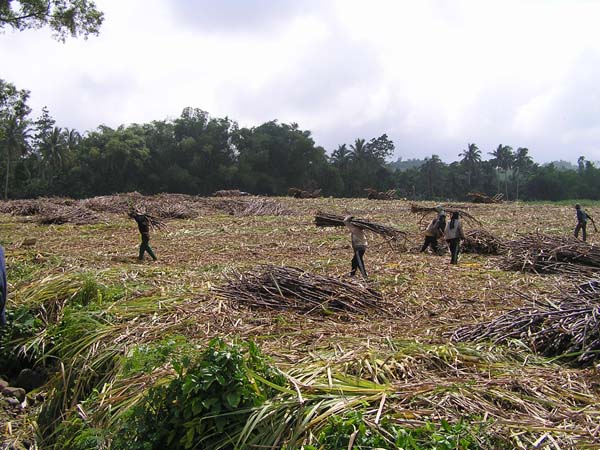 There are only a few hectares left. The last parcels are being harvested. The dry season has started, and the summer sun is beating down on the sakadas. They hack away at the canes, piling them neatly in rows between the canes. They will carry these to the carabao sleds, which will fill up with harvested cane, which in turn will take them to the trucks. The sakadas will then load them in neat stacks, and the truck, once it is full, will then deliver it to Central Azucarera de La Carlota for milling. And this is how it goes every day, since November, when they started harvesting sugar cane in Hacienda Dos Marias.
But once in a while, something disrupts the monotony of harvest—maral kittens! This is how it was for a group of sakadas on Parcel 15 earlier this afternoon. They came upon a ‘nest’, under a clump of cane. Either the mother has abandoned her kittens, or she left them there to hunt for food. The sakadas got the kittens, and because they were already feisty, one of them tied each of the kitten’s legs and put them in his rucksack. He surrendered the kittens to the Maral Project, and we turned it in to the Negros Forests & Ecological Foundation, Inc. (NFEFI) in Bacolod. But some kittens, or mothers, are not so lucky.
 Often, when a nest is uncovered, and the mother chooses to fight, she gets killed by the cane cutters. Kittens are taken home by the cutters, sometimes divided up amongst themselves when there is more than one kitten. Some of them turn up in the local wet markets being sold as pets, while others were simply brought home to the children. Either way, these cats do not survive because they are fed table scraps, and children can sometimes be cruel to animals. At about three to four months of age, these kittens start getting feisty, and can no longer be petted.
This is the story of the orphans of the sugar cane fields of Negros. And this is how IT all began.

NB: We thank William Oliver for letting us borrow the title "Orphans of the sugar cane fields", which is the title of his unpublished article about the leopard cats of Negros.
Thursday, February 17, 2011
All in a day's work
It was the second transect day of the month. Transects 3 and 6 are on the northern part of the hacienda while 15 and 16 are on the southern edge; a very long walk. As my eyes scoured the ground for tracks and scats, and as I walk from one transect to another, my mind collated what had transpired and what hadn’t during what I considered, the First Half.
We mapped the entire hacienda, established our transects, put up our hair snares, and put out our live traps. We found scats and tracks, and in rare times, what we suspect to be bird kills by leopard cats. The hair snares never attracted anything but dust and mud. And the traps remained empty save for the live bait. We got sick on field, thankfully, quite rarely. Some of our live bait died and had to be replaced. One sakada (cane cutter) was killed by another sakada, and since no one knew who it was, or more accurately, no one would speak up on who it was, the person involved in the murder is still working in the hacienda. And the cane is almost gone.
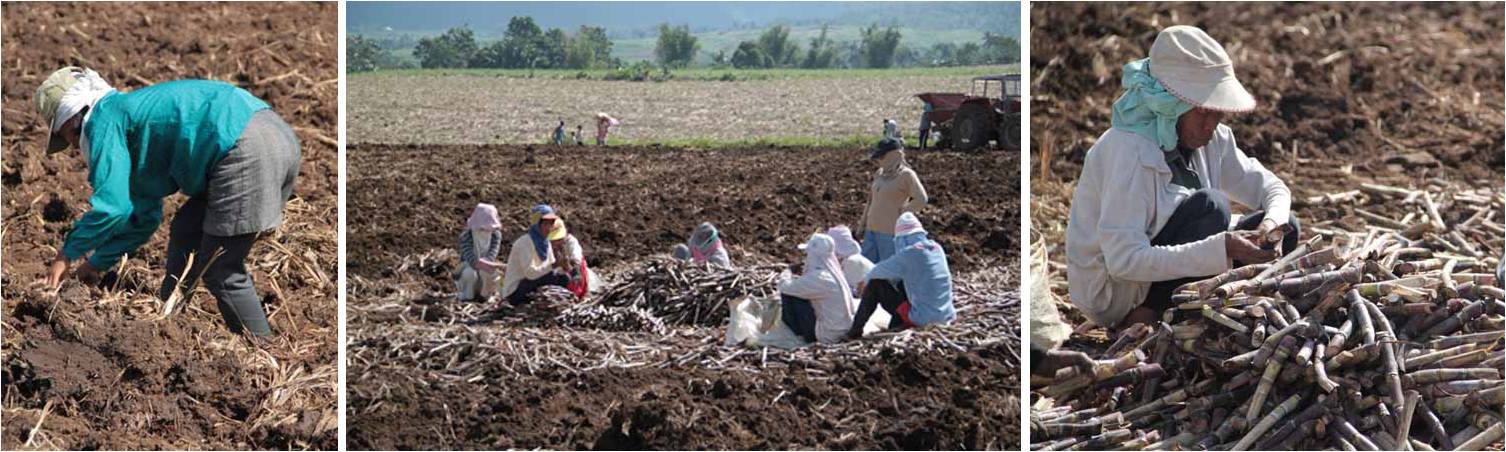
I passed by a group of women in one of the newly plowed fields. Some were sorting planting materials, while some were distributing planting materials between rows, and the rest were on their hands and knees, planting cane. It was a little past 10 in the morning, and the sun was high up. Most of the women looked up as I passed, so I called out a ‘good morning’ and waved a friendly hand. They wave back. They were wearing long-sleeved shirts, skirts or shorts over trousers, and head protection consisting of a t-shirt draped over the head tied securely around the forehead by a towel or another piece of t-shirt, or hats.
I approached one sorting party and chatted with them. They’ve been on the field since dawn, and they’ll be there until the afternoon, when they finished this parcel. It was only past 10 in the morning, but the sun is scorching, and there was no cover to be had. It must’ve been around about 32 °C, and it will only get hotter as the day progresses. These women will get burned. And they do, every day, working in these cane fields since harvest started in October. But at least there is work. Come off harvest starting June, and while cane is growing, the cane fields of Negros are usually empty, save for some maintenance activities.
I bid them goodbye, and turned towards Transect 3. The continued their work under the scorching heat. All in a day’s work.

We mapped the entire hacienda, established our transects, put up our hair snares, and put out our live traps. We found scats and tracks, and in rare times, what we suspect to be bird kills by leopard cats. The hair snares never attracted anything but dust and mud. And the traps remained empty save for the live bait. We got sick on field, thankfully, quite rarely. Some of our live bait died and had to be replaced. One sakada (cane cutter) was killed by another sakada, and since no one knew who it was, or more accurately, no one would speak up on who it was, the person involved in the murder is still working in the hacienda. And the cane is almost gone.
I passed by a group of women in one of the newly plowed fields. Some were sorting planting materials, while some were distributing planting materials between rows, and the rest were on their hands and knees, planting cane. It was a little past 10 in the morning, and the sun was high up. Most of the women looked up as I passed, so I called out a ‘good morning’ and waved a friendly hand. They wave back. They were wearing long-sleeved shirts, skirts or shorts over trousers, and head protection consisting of a t-shirt draped over the head tied securely around the forehead by a towel or another piece of t-shirt, or hats.
I approached one sorting party and chatted with them. They’ve been on the field since dawn, and they’ll be there until the afternoon, when they finished this parcel. It was only past 10 in the morning, but the sun is scorching, and there was no cover to be had. It must’ve been around about 32 °C, and it will only get hotter as the day progresses. These women will get burned. And they do, every day, working in these cane fields since harvest started in October. But at least there is work. Come off harvest starting June, and while cane is growing, the cane fields of Negros are usually empty, save for some maintenance activities.
I bid them goodbye, and turned towards Transect 3. The continued their work under the scorching heat. All in a day’s work.
Saturday, November 20, 2010
A different ballgame
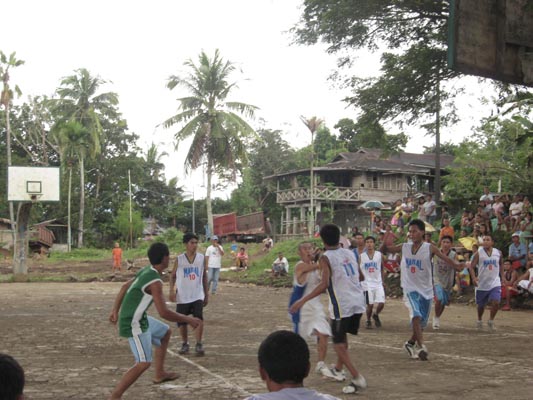 Basketball to Filipinos is like football (soccer) to Brazilians. We just love the game. So much so that if one goes around the Philippines, you’ll find basketball courts in villages everywhere, even in the middle of the streets (the two rings are on either side of the street). Not to mention a lot of the work offices, both private and government. And, everyone watches.
As such, I thought it would be a good idea to have one of the basketball teams of the hacienda carry the name ‘Maral’ (the local name for the leopard cat). After all, everyone comes to the game, even people from other haciendas. This annual basketball league games start from the second week of November and lasts until before Christmas; quite a bit of exposure for the leopard cat, and an unconventional one at that.
So I went to my first game earlier today. The team’s jerseys were just hot off the tailoring shop, and I was eager to see how they’d fare. More importantly, I was anxious to see how the audience will receive them. This is already their second game, and they had changed their name from ‘Wildcats’ to ‘Maral’.
The game has already started by the time we got there. My team is on its element. And the people were cheering: "Maral! Maral!" I was fervently hoping that subconsciously, their cheers for the cat that frequents their cane fields will penetrate them, and that consciously, they will be our allies in conservation.
Wednesday, November 17, 2010
“…We will understand only what we are taught.”
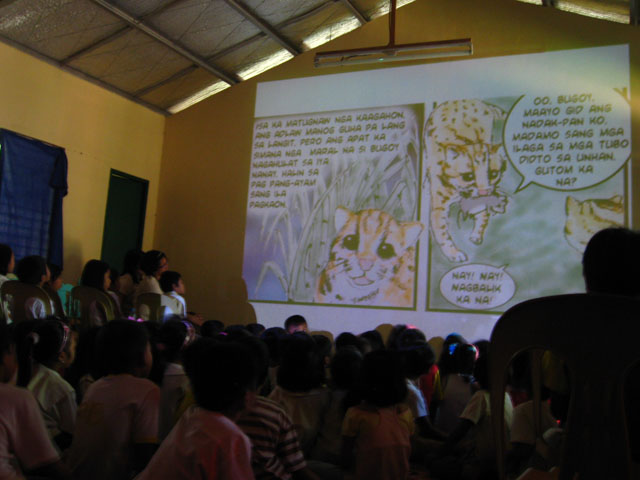 It was our trial run: Ara-al Elementary School. Having experienced doing a full-on lecture with elementary students, I begged off this time. I wanted to do something that is easily digested, informative, fun, and something that will get them to think. We succeeded with the story-telling and the modified 20 Questions.
However, there is one huge frustration, and I noticed this when I played Frans Lanting’s 2005 TED talk to pass time while one class goes out and another comes in. The children, in all levels, readily identified the large African mammals. I thought, I wonder how they’d do with Philippine wildlife? I already had a hunch they won’t do as well as they did with the African fauna, and I was proven right when I flashed a leopard cat photo and the class roared, “Tiger!”
I would’ve thought that these children, who are growing up in an area teeming with native wildlife, would know them. City kids don’t fare well with native wildlife because TV exposed them to exotic fauna, and having grown up in the city, is limited to pets and commensal species. But apparently, these rural kids are about the same.
My frustration is two-pronged. One is with their teachers, who it turns out, teach their kids exactly what they know and were able to identify (i.e. exotic megafauna). And the second, and more important one, is with myself and colleagues in the conservation sciences. And the first is actually very much connected to the second.
How many of us scientists will admit that we lack the ability to communicate ourselves to those we call the general public? Even more so, how many of us will admit that we cannot teach?

Having read quite a few papers, scientific publication isn’t really very digestible. And I’d probably get shot for saying this, but it is boring, and frigid. Boring and frigid to those who do not belong in that field. I’ve spent about six years in two universities, and I’ve had numerous professors, most of them scientists. Almost all of them shine in their respective fields, and are well-respected by colleagues. But only a handful can actually reach out to their students; communicate with them (as opposed to ‘TO them’); and impart themselves to their students.
My thoughts? For those who can teach, teach. For most of us who can’t, inform those who teach.
Tuesday, November 9, 2010
A hectare a day
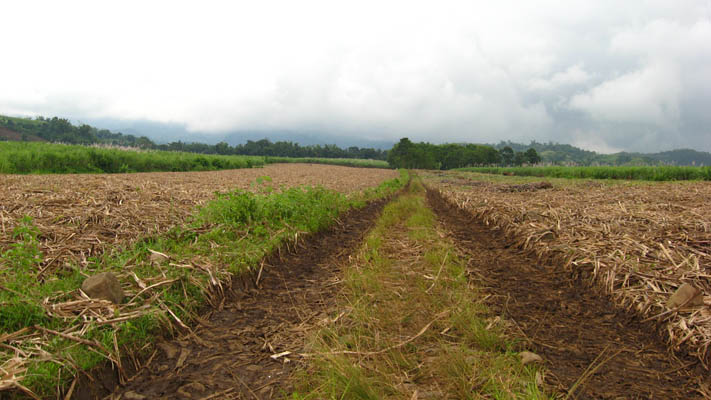
It’s only been a week since harvest started, and already, it has changed the landscape dramatically. It’s not that I have not seen a harvested field; it’s that it feels quite different to see what used to be vast expanse of sugarcane turn into fields of dried cane leaves, flat on the ground, one hectare a day. The sound of the wind as it rustles through the tall cane is no more. I no longer hear the sounds of the birds shuffling under the cane, nor do I see them perching amongst the leaves. It is unsettling to walk through these fields without the cane overshadowing me. I remember taking shelter amongst them, when one rainy transect day, lightning hit close to the ground. What if we have another one of those lightning-happy days? There will be no more cane to take cover in.
As I gaze upon these harvested fields, I am frustrated by my continued inability to answer one of the fundamental questions of this research: where do the leopard cats go?
Tuesday, November 2, 2010
The doldol tree

I heard this story when I was still working with FFI-PBCP doing an ethnobiological survey of the distribution and conservation status of the leopard cat. I was talking to the women in an upland barangay in Antique, and they said, “You know the doldol [Ceiba pentandra] means a great deal to us.” “How so?,” I wondered out loudly to them. They smiled, “Because when the doldol dehisces, we know our men will be coming home soon.”
The sakadas arrived in the hacienda the day before. There are about 70 of them; all of them from Antique. As I stood before them early this morning, discussing the project, I peered through their faces. Some are young, some are about my age, and some are older. In the next seven months, these men will be harvesting the cane. They will be seeing our live traps, and our hair snares. Chances are, they will be uncovering kitten, encountering adult cats. We need to know if they do. I also asked them to let the cats be. I explained why. They seem to understand. Some were nodding their heads. Most were just listening.
We shall see. I am hopeful though.
Saturday, October 30, 2010
Hello, food
We went out early in the morning to make a round of the traps. While on our way down Transect 8 where two traps were deployed, we noticed leopard cat tracks heading east. We hurried to the first trap. Nothing. We did the usual routine of replenishing the food and water, and hurried on to the next one. Nothing. As we walked to the next trap in Transect 12, we saw more tracks, still heading east. It looks as if the cat just passed by two of our traps.
The cat probably took a look at the live bait in the trap, and said, “Hello, food. Too bad you’re in the trap.” And passing the second one, it must’ve said, “Tsk tsk tsk. Such a waste!”
The cat probably took a look at the live bait in the trap, and said, “Hello, food. Too bad you’re in the trap.” And passing the second one, it must’ve said, “Tsk tsk tsk. Such a waste!”
Wednesday, October 27, 2010
Hope for harvest
We did the usual things we do every morning when we check traps: make coffee, get the chicks that will be replacing yesterday’s bait ready, prep some food and water for our live baits, and then take off. This morning was different though. Today will be the blessing of the cane.
It started only about three years ago for this hacienda. People come to pray for a good harvest season, which will last from November to around June of next year. One may think that with the onset of harvest, the crop year has come to a full cycle. It hasn’t. Many things can still go wrong during the long harvest period. The female pastor’s prayer revealed so much of the dynamics of cane harvest, and for someone who didn’t grow up in a farm, it was fascinating for me. It wasn’t only inclement weather, or pest, but the people themselves, who are involved in harvest.
In a few days, the sakadas (cane cutters who were hired by a middleman from another place or island) will come to the hacienda. They will be housed in the quarters solely their own in the middle of the tiny hacienda village. Having so many people in such a small place for an extended period of time creates negative energy sometimes, and it was not only once that we were told of fights breaking up between the locals and the sakadas.
But today everyone is hopeful. That this harvest season will bring not only the owner, but also the people, a bit of blessing, and the hacienda, peace.
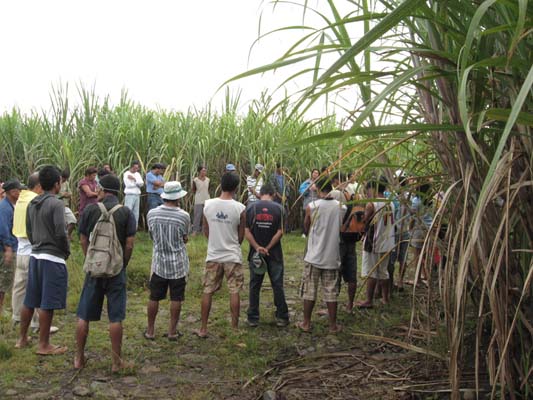 yesterday’s bait ready, prep some food and water for our live baits, and then take off. This morning was different though. Today will be the blessing of the cane.
It started only about three years ago for this hacienda. People come to pray for a good harvest season, which will last from November to around June of next year. One may think that with the onset of harvest, the crop year has come to a full cycle. It hasn’t. Many things can still go wrong during the long harvest period. The female pastor’s prayer revealed so much of the dynamics of cane harvest, and for someone who didn’t grow up in a farm, it was fascinating for me. It wasn’t only inclement weather, or pest, but the people themselves, who are involved in harvest.
In a few days, the sakadas (cane cutters who were hired by a middleman from another place or island) will come to the hacienda. They will be housed in the quarters solely their own in the middle of the tiny hacienda village. Having so many people in such a small place for an extended period of time creates negative energy sometimes, and it was not only once that we were told of fights breaking up between the locals and the sakadas.
But today everyone is hopeful. That this harvest season will bring not only the owner, but also the people, a bit of blessing, and the hacienda, peace.
Saturday, October 23, 2010
Marar! Marar!

For the last three weeks, we’ve been passing through a shortcut Jeric discovered on our way to the traps. We’d pass by this small hut, and there’s always these two kids shyly looking at us. Niño and Niña are siblings, only a year within each others’ age, 3 or 4. They’d whisper to each other: “Marar!” (their way of saying maral, the local term for leopard cat). Lately, I think their shyness has dissolved, and every time we pass by their hut, or their cornfields, they’ll shout in greeting, “Marar! Marar! Marar!” How can one not smile and wave back?
Saturday, October 16, 2010
Tabo-an
We woke up early today to check the traps, and retrieve the chicks; traps will be closed for the weekend. We hurried home after, knowing we need to leave Araal early. Today is the tabo-an. While it literally means meeting, tabo-an in Ilonggo is ‘market day’, the day when crop-producing barangays come down to the town market to sell their produce. Fruits, meat, fish, vegetables, and eggs are cheaper compared to a regular day at the market. It is also when kakanin, any delicacy made from glutinous rice, will be sold everywhere.
We started off with the groceries, not knowing today was a big sale day for the only supermarket in town. Lopue’s La Carlota was packed, and it was only 8:30 in the morning! Jeric left to purchase the things we needed from the wet market, while I was left to wait patiently for my turn at the cashier. We have had several incidence with the guard and the cashier at that supermarket. They didn’t want us to use our own bag, and the last time I was there, I got irritated that I went straight to the manager and complained. He was nice enough, but I guess since then, I earned myself a reputation at Lopue’s. I left for the market afterwards. I’m excited. Today is my first tabo-an.
I was amazed at what I saw. The streets surrounding the market were filled with vendors selling everything from tomatoes to dried fish to second-hand clothing. I roamed around, my eyes feasting on all these. I purchased a few things we need, and proceeded to the tricycle terminal where I’m meeting Jeric.
I love tricycles from Araal! You can ask them to take your water container, have it refilled at the water refilling station, and have them take your container back to your place—for only PhP20 for the whole trip! Or you can leave a boxful or groceries at Lopue’s, go into town to do some marketing, take the trike, and ask them to pass by Lopue’s so you can retrieve your groceries and take it home with you. Which is exactly what we did on our way back to Ara-al.
We started off with the groceries, not knowing today was a big sale day for the only supermarket in town. Lopue’s La Carlota was packed, and it was only 8:30 in the morning! Jeric left to purchase the things we needed from the wet market, while I was left to wait patiently for my turn at the cashier. We have had several incidence with the guard and the cashier at that supermarket. They didn’t want us to use our own bag, and the last time I was there, I got irritated that I went straight to the manager and complained. He was nice enough, but I guess since then, I earned myself a reputation at Lopue’s. I left for the market afterwards. I’m excited. Today is my first tabo-an.
I was amazed at what I saw. The streets surrounding the market were filled with vendors selling everything from tomatoes to dried fish to second-hand clothing. I roamed around, my eyes feasting on all these. I purchased a few things we need, and proceeded to the tricycle terminal where I’m meeting Jeric.
I love tricycles from Araal! You can ask them to take your water container, have it refilled at the water refilling station, and have them take your container back to your place—for only PhP20 for the whole trip! Or you can leave a boxful or groceries at Lopue’s, go into town to do some marketing, take the trike, and ask them to pass by Lopue’s so you can retrieve your groceries and take it home with you. Which is exactly what we did on our way back to Ara-al.
Wednesday, October 6, 2010
Lamentation
Blisters on my feet; cane cuts on my face
Long walks under the sweltering heat,
Or the cold Araal rain
Still, no cat
We know they’re there—
We’ve seen the tracks,
And collected the scats
Why can’t we get them to go in the traps???
Long walks under the sweltering heat,
Or the cold Araal rain
Still, no cat
We know they’re there—
We’ve seen the tracks,
And collected the scats
Why can’t we get them to go in the traps???
Friday, October 1, 2010
Live bait
How would you feel if you were left for days in a trap, with only your feeder and waterer to accompany you in the bait compartment? I would be traumatized, I imagine.
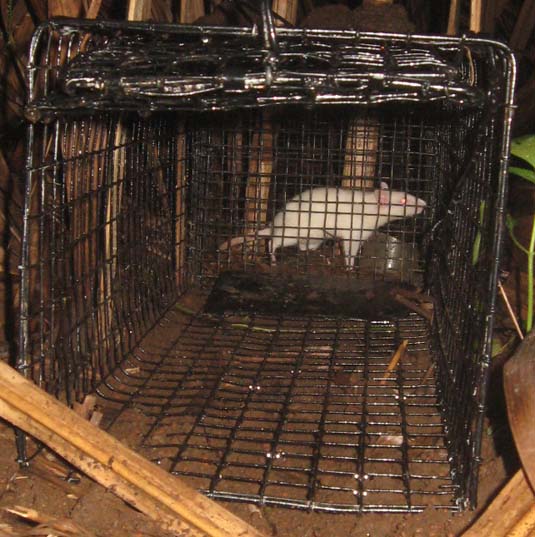
We didn’t take the traps, or baits, out in the morning, and I visited them alone this afternoon to replenish their food and water supply. Tom was her usual perky self, but no longer panicky. She also up-ended her feeder, scattering food all over the trap floor. I replenished her food and water, and scolded her a bit for throwing away her food. Geri was better with her food, but I threw it away because it got wet when it rained hard earlier in the afternoon. I also gave her some water. The moment I set down her waterer, Geri started drinking. I apologized for the delay in delivering water to her; I gave her some more.
I walked to where the first trap baited with chick was. I’m beginning to hate the vines that grow between cane rows. I almost always get caught in them, either my neck, or my feet. As I got closer to the trap, the chick started yipping loudly. I told it, “It’s ok, it’s just me.” I quickly got to it, gave it more food and water; it was hungry. I said, “I’m sorry; next time we’ll bring you food earlier.” I moved to the next trap. The chick yipped even louder when I bent down to take the bamboo stakes out to open the bait compartment door. It was scared. I put my hand in, and it kipped under it. When I moved to get the waterer and feeder, it yipped again, and when I put my hand on it, it stopped. I crooned to it. I was sorry to leave it on it’s own. Before I left, I said, “Get me a cat, will you?” I went on to check the last one. It didn’t have any more food, or water, so I gave it some. It was thirsty. I gave it some more water.
It was almost 6 PM by the time I finished my round of the traps. I was exhausted. I realized I moved more quickly when Jeric’s not around. I also realized that my memory served me well, at least in finding the traps. They were all set deep within a cane field, and only a braid of cane leaves mark the entrance to the row where the traps were set.
I walked slowly on my way home. I love these walks. They induce me to think. I thought, there must be some improvement we can do on the traps. Camouflage the floor more, perhaps.
We didn’t take the traps, or baits, out in the morning, and I visited them alone this afternoon to replenish their food and water supply. Tom was her usual perky self, but no longer panicky. She also up-ended her feeder, scattering food all over the trap floor. I replenished her food and water, and scolded her a bit for throwing away her food. Geri was better with her food, but I threw it away because it got wet when it rained hard earlier in the afternoon. I also gave her some water. The moment I set down her waterer, Geri started drinking. I apologized for the delay in delivering water to her; I gave her some more.
I walked to where the first trap baited with chick was. I’m beginning to hate the vines that grow between cane rows. I almost always get caught in them, either my neck, or my feet. As I got closer to the trap, the chick started yipping loudly. I told it, “It’s ok, it’s just me.” I quickly got to it, gave it more food and water; it was hungry. I said, “I’m sorry; next time we’ll bring you food earlier.” I moved to the next trap. The chick yipped even louder when I bent down to take the bamboo stakes out to open the bait compartment door. It was scared. I put my hand in, and it kipped under it. When I moved to get the waterer and feeder, it yipped again, and when I put my hand on it, it stopped. I crooned to it. I was sorry to leave it on it’s own. Before I left, I said, “Get me a cat, will you?” I went on to check the last one. It didn’t have any more food, or water, so I gave it some. It was thirsty. I gave it some more water.
It was almost 6 PM by the time I finished my round of the traps. I was exhausted. I realized I moved more quickly when Jeric’s not around. I also realized that my memory served me well, at least in finding the traps. They were all set deep within a cane field, and only a braid of cane leaves mark the entrance to the row where the traps were set.
I walked slowly on my way home. I love these walks. They induce me to think. I thought, there must be some improvement we can do on the traps. Camouflage the floor more, perhaps.
Saturday, September 25, 2010
Yet again…
Instead of baiting the hair snares this morning, we set out with the carpenters who will be working on our observation posts to gather the bamboo. I enjoyed the ride on the tractor, although I probably have numerous cuts from the cane, again. We also saw some edible mushrooms on the way, and although Jeric was first to get to them, I asked him to give them to carpenters. The real Platform Day will be tomorrow!
Our third attempt, yes. With the help of the village hunter, we set up two traps. Walking through the Transect 13, manong Ronnie would peer inside the cane from time to time. I guess he’s trying to think like a cat; something I’ve failed to do several times already. He stopped. We went in. This time, we went further inside parcel 5. Tom was unwilling to go inside the bait compartment. Quite understandable. The set up was basically the same; nong Ronnie didn’t put soil to camouflage the trap floor though. From parcel 5, we went further in. We’re going to parcel 13 THROUGH the cane. I braced myself. Off to #13 we go, winding through the cane, wincing every time a blade catches some bare skin. He stopped, and again, he bent down and leveled the soil. This is where we’re setting the second one up. Same procedure. We tried the treadle-and-door mechanism several times, and like Tom’s trap, Jerry’s was working well. We stood up, and I braced myself again for more cane. We went straight home.
Our third attempt, yes. With the help of the village hunter, we set up two traps. Walking through the Transect 13, manong Ronnie would peer inside the cane from time to time. I guess he’s trying to think like a cat; something I’ve failed to do several times already. He stopped. We went in. This time, we went further inside parcel 5. Tom was unwilling to go inside the bait compartment. Quite understandable. The set up was basically the same; nong Ronnie didn’t put soil to camouflage the trap floor though. From parcel 5, we went further in. We’re going to parcel 13 THROUGH the cane. I braced myself. Off to #13 we go, winding through the cane, wincing every time a blade catches some bare skin. He stopped, and again, he bent down and leveled the soil. This is where we’re setting the second one up. Same procedure. We tried the treadle-and-door mechanism several times, and like Tom’s trap, Jerry’s was working well. We stood up, and I braced myself again for more cane. We went straight home.
Subscribe to:
Posts (Atom)