Showing posts with label people. Show all posts

Saturday, April 23, 2011

Reputation

Jeric was paying at the cashier of Lopue’s La Carlota, practically the only reliable grocery store in town. The bagger was a trainee, as evinced by the printed letters on his shirt. He caught one of the older baggers pointing to Jeric, saying to his trainee, “That’s them!”

A few weeks back, in the same grocery store, the new security guard was going through our purchases. Jeric waited patiently for him to finish his inspection, mum on what’s going on but smiling to himself. One of the older baggers noticed him after a while and shouted: “It’s ok, they really use their own bag when they shop here; let them through!”

About nine months ago, when we’ve only been for a few weeks, when Jeric and I went to Lopue’s La Carlota to purchase our weekly supply of groceries. As we’ve done in the few times we went there to shop, we brought our own bags. We were about to pay so I handed the bagger our bags, and asked him politely to use them to bag our stuff. He hesitated and said, “I’m sorry mam, but you have to use your plastic bags.” He was about to grab one of the pink-colored plastic bags when I stopped him and said, “Please, we’d like to use our own bags.” He wouldn’t budge, so I we bagged our purchases ourselves, to his consternation, in the bags we brought, and I went straight to the manager’s desk.

I greeted him in the local language, introduced myself, and said, “I’m sorry to disturb you, but I think we have a problem here….” I proceeded to tell him that people should be allowed to use their own bags when shopping to reduce plastic and paper waste.  It was a pleasant chat and we left the store with the manager in our side of the fence.

Apparently after that, we’ve developed quite a reputation.

Thursday, February 17, 2011

All in a day's work

It was the second transect day of the month. Transects 3 and 6 are on the northern part of the hacienda while 15 and 16 are on the southern edge; a very long walk. As my eyes scoured the ground for tracks and scats, and as I walk from one transect to another, my mind collated what had transpired and what hadn’t during what I considered, the First Half.

We mapped the entire hacienda, established our transects, put up our hair snares, and put out our live traps. We found scats and tracks, and in rare times, what we suspect to be bird kills by leopard cats. The hair snares never attracted anything but dust and mud. And the traps remained empty save for the live bait. We got sick on field, thankfully, quite rarely. Some of our live bait died and had to be replaced. One sakada (cane cutter) was killed by another sakada, and since no one knew who it was, or more accurately, no one would speak up on who it was, the person involved in the murder is still working in the hacienda. And the cane is almost gone.

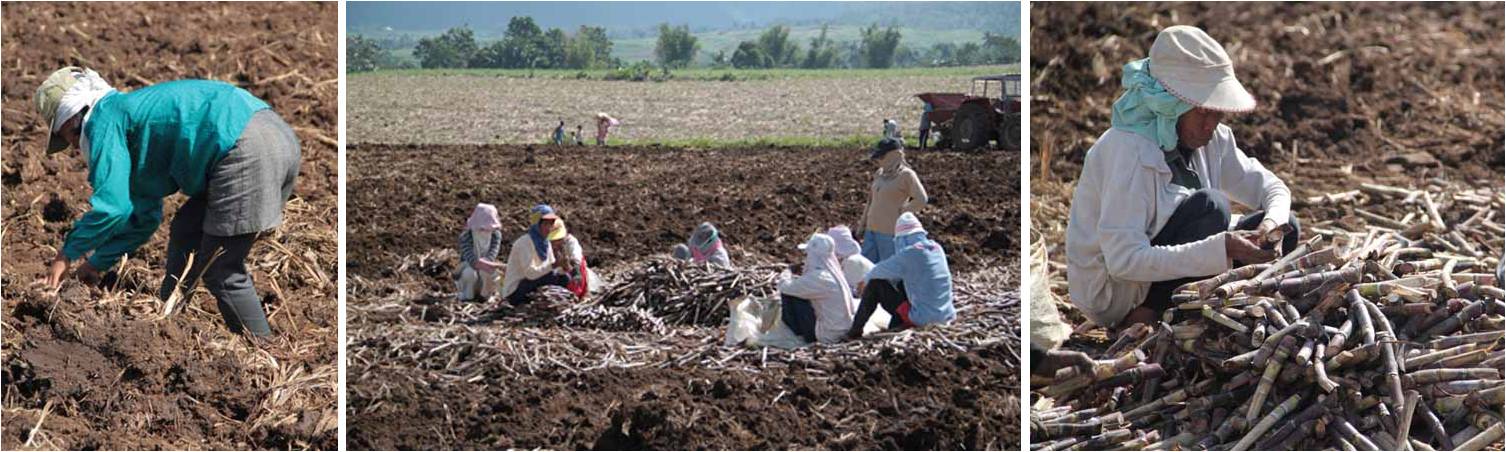
I passed by a group of women in one of the newly plowed fields. Some were sorting planting materials, while some were distributing planting materials between rows, and the rest were on their hands and knees, planting cane. It was a little past 10 in the morning, and the sun was high up. Most of the women looked up as I passed, so I called out a ‘good morning’ and waved a friendly hand. They wave back. They were wearing long-sleeved shirts, skirts or shorts over trousers, and head protection consisting of a t-shirt draped over the head tied securely around the forehead by a towel or another piece of t-shirt, or hats.

I approached one sorting party and chatted with them. They’ve been on the field since dawn, and they’ll be there until the afternoon, when they finished this parcel. It was only past 10 in the morning, but the sun is scorching, and there was no cover to be had. It must’ve been around about 32 °C, and it will only get hotter as the day progresses. These women will get burned. And they do, every day, working in these cane fields since harvest started in October. But at least there is work. Come off harvest starting June, and while cane is growing, the cane fields of Negros are usually empty, save for some maintenance activities.

I bid them goodbye, and turned towards Transect 3. The continued their work under the scorching heat. All in a day’s work.


Tuesday, November 2, 2010

The doldol tree


I heard this story when I was still working with FFI-PBCP doing an ethnobiological survey of the distribution and conservation status of the leopard cat. I was talking to the women in an upland barangay in Antique, and they said, “You know the doldol [Ceiba pentandra] means a great deal to us.” “How so?,” I wondered out loudly to them. They smiled, “Because when the doldol dehisces, we know our men will be coming home soon.”

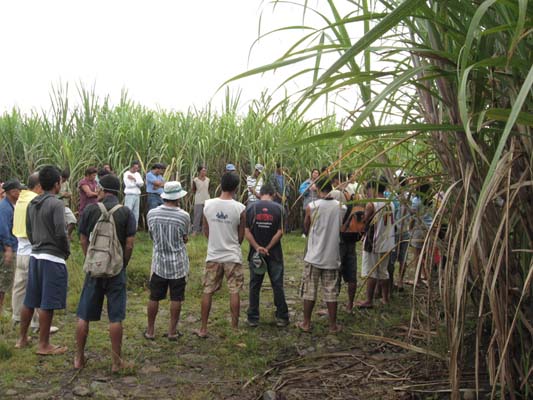
The sakadas arrived in the hacienda the day before. There are about 70 of them; all of them from Antique. As I stood before them early this morning, discussing the project, I peered through their faces. Some are young, some are about my age, and some are older. In the next seven months, these men will be harvesting the cane. They will be seeing our live traps, and our hair snares. Chances are, they will be uncovering kitten, encountering adult cats. We need to know if they do. I also asked them to let the cats be. I explained why. They seem to understand. Some were nodding their heads. Most were just listening.

We shall see. I am hopeful though.

Wednesday, October 27, 2010

Hope for harvest

We did the usual things we do every morning when we check traps: make coffee, get the chicks that will be replacing yesterday’s bait ready, prep some food and water for our live baits, and then take off. This morning was different though. Today will be the blessing of the cane.

It started only about three years ago for this hacienda. People come to pray for a good harvest season, which will last from November to around June of next year. One may think that with the onset of harvest, the crop year has come to a full cycle. It hasn’t. Many things can still go wrong during the long harvest period. The female pastor’s prayer revealed so much of the dynamics of cane harvest, and for someone who didn’t grow up in a farm, it was fascinating for me. It wasn’t only inclement weather, or pest, but the people themselves, who are involved in harvest.

In a few days, the sakadas (cane cutters who were hired by a middleman from another place or island) will come to the hacienda. They will be housed in the quarters solely their own in the middle of the tiny hacienda village. Having so many people in such a small place for an extended period of time creates negative energy sometimes, and it was not only once that we were told of fights breaking up between the locals and the sakadas.

But today everyone is hopeful. That this harvest season will bring not only the owner, but also the people, a bit of blessing, and the hacienda, peace.

Saturday, October 23, 2010

Marar! Marar!


For the last three weeks, we’ve been passing through a shortcut Jeric discovered on our way to the traps. We’d pass by this small hut, and there’s always these two kids shyly looking at us. Niño and Niña are siblings, only a year within each others’ age, 3 or 4. They’d whisper to each other: “Marar!” (their way of saying maral, the local term for leopard cat). Lately, I think their shyness has dissolved, and every time we pass by their hut, or their cornfields, they’ll shout in greeting, “Marar! Marar! Marar!” How can one not smile and wave back?

Sunday, July 25, 2010

First days

It would’ve been nice if this was just a lazy Sunday morning. Instead, I am feeling restless. I should be out there mapping, not sitting in the rest house and fiddling with ArcGIS ©, trying to recall old lectures and lab exercises. My back is still killing me. I should’ve been more careful yesterday, then I wouldn’t be sitting here feeling useless.

I was proud of what we accomplished yesterday morning: we mapped out the entire perimeter of the hacienda. My guide, manong Oca, was late in picking me up in the afternoon. It had already started raining on our way to Najalin River. I trekked slowly; water sliding down compacted mud makes for a good sliding down, way down. No thanks. We got to the river. I really wanted to get the edge of the property so I asked my guide if we can river trek to get there.  He was fine with it. Then he started rock-hopping. I was clambering laboriously over huge boulders, careful not to slip. It was raining heavily now. We haven’t really gone far when I stopped. This poncho is a nuisance! I took it off as my guide watches in disbelief, like getting soaked is unheard of in this part of the world. “Day, mabasa ka gid!” [you’re going to get soaking wet!] I said I’d rather get drenched than break a hip. He shrugged. We went on. I would stop every now and then to get geographic coordinates for that area. I didn’t care so much that I was getting soaked to the bones, but I did worry about the GPS. Would thumbing the keys allow water to seep through the equipment? I hope not.

On the trail going back up, I was still mapping but I was already shivering. I was soaked, and the wind wasn’t going to be kind. We hurried home.

That evening, I couldn’t sleep. Our first days on field. I’m excited. My thoughts were punctuated by a symphony: male frogs calling to the females; insects humming; rain falling; leaves rustling; fruit bats fighting over some fruit in a nearby tree; the Tockay gecko calling every now and then. It was almost one in the morning.

Monday, July 19, 2010

In recognition

First off, we would like to recognize the people and organizations with whom this project owes its humble beginnings:

Collaborative Lab for Asian Wildlife Studies | Conservation Biology Program-UMN | Council of Graduate Students-UMN | Dayton-Wilkie Natural History Funds | Field Museum of Natural History | Ford Foundation-International Fellowships Program | Ideawild | Negros Forests & Ecological Foundation, Inc. | Philippines Biodiversity Conservation Program | Rufford Small Grants

Dr Todd Arnold | Dr Francie Cuthbert | Dr Larry Heaney |Gerry Ledesma | Paul Lizares | Dr Rajan Rajaratnam | Dr Dave Smith | Dr Karen Oberhauser | William Oliver

As this project goes through its phases, there will be more people added to this list, and hopefully, more organizations as well. Maraming, maraming salamat po for getting us started!