Showing posts with label Philippines. Show all posts

Sunday, May 1, 2011

Crappy science-- literally!

My apologies for using the word; I do not intend to cuss. But please read on, for there is a lot we can learn from sh*t.

Alright, let’s be a bit more scientific. We’ve been collecting leopard cat scats (poop, sh*t, crap… call it what you want) for the last 10 months we’ve been here on field. So far, we have 50-something scats stored in 95% ethanol in little plastic bottles (plastic vials with stopper are rare and expensive here). I wasn’t intending to study diet at all, but given our failure to trap leopard cats, might as well use them in my thesis.

So about a couple of weeks ago, I started doing my analysis on our samples. I tell you, after this, I will always associate the smell of ethanol with leopard cat scat! It’s quite a strong smell, but once you get over the odor, you get into the groove of scatology (i.e. the study of poop).

Ella Fitzgerald, Bach, Kimya Dawson, Carlos Vives, Parokya ni Edgar, The Corrs, John Prine, Greenday, and everything else in between keeps me company during my literally shitty moments. My ‘laboratory’ consists of a 1.7 mm sieve on a makeshift bamboo frame, a couple of pointy barbecue sticks, a pair of forceps, hot water in a plastic pail with a plastic tabo (dipper), a piece of cardboard I ripped off a box which I use to sit on, and a magnifying glass, which is perhaps the most sophisticated piece of equipment in the list. I would hunch over my sieve, wearing a mask over my face (no, it doesn’t help with the smell) and a pair of surgical gloves, picking through the soil, hair, bones, and everything else that makes up a leopard cat scat. I would take the tiny bone fragments, wash them carefully, and store them in small brown paper bags, properly labeled. I will be bringing these specimens with me back to the US, where I will seek the help of the experts from the Field Museum of Natural History in Chicago to identify whether these fragments came from a bird, a mammal, a reptile or an amphibian (leopard cats are obligate carnivores, i.e. they eat only meat).

Diet is not the only thing one can learn from poop. Hormones can be extracted from them as well, and it can tell us about stress levels, or on what reproductive stage a female animal is. Parasite ova (eggs) can also be gleaned from scats. One can also determine how healthy an animal is from its excreta. And, DNA can also be extracted from scats. Depending on DNA quality, we can now be able to ID who owns it; how many individuals there are in our samples; what species of plants or animals the owner of the scat ate, and a few more possibilities (NB: Apologies to my colleagues for making this sound a bit more simple than it is!)

Pre-scat days, biologists used to capture animals, and gut them to obtain the stomach to study diet; they used to draw blood to determine the levels of stress hormones (which, duh, complicates the matter seeing as it stresses an animal during handing and capture!) With the advancement of science of shit, we can study a lot about the physiology, health, and ecology of an animal non-invasively (i.e. without having to capture, handle or sacrifice an animal).

Now that is Crappy Science!!!

Saturday, April 23, 2011

Reputation

Jeric was paying at the cashier of Lopue’s La Carlota, practically the only reliable grocery store in town. The bagger was a trainee, as evinced by the printed letters on his shirt. He caught one of the older baggers pointing to Jeric, saying to his trainee, “That’s them!”

A few weeks back, in the same grocery store, the new security guard was going through our purchases. Jeric waited patiently for him to finish his inspection, mum on what’s going on but smiling to himself. One of the older baggers noticed him after a while and shouted: “It’s ok, they really use their own bag when they shop here; let them through!”

About nine months ago, when we’ve only been for a few weeks, when Jeric and I went to Lopue’s La Carlota to purchase our weekly supply of groceries. As we’ve done in the few times we went there to shop, we brought our own bags. We were about to pay so I handed the bagger our bags, and asked him politely to use them to bag our stuff. He hesitated and said, “I’m sorry mam, but you have to use your plastic bags.” He was about to grab one of the pink-colored plastic bags when I stopped him and said, “Please, we’d like to use our own bags.” He wouldn’t budge, so I we bagged our purchases ourselves, to his consternation, in the bags we brought, and I went straight to the manager’s desk.

I greeted him in the local language, introduced myself, and said, “I’m sorry to disturb you, but I think we have a problem here….” I proceeded to tell him that people should be allowed to use their own bags when shopping to reduce plastic and paper waste.  It was a pleasant chat and we left the store with the manager in our side of the fence.

Apparently after that, we’ve developed quite a reputation.

Thursday, February 17, 2011

All in a day's work

It was the second transect day of the month. Transects 3 and 6 are on the northern part of the hacienda while 15 and 16 are on the southern edge; a very long walk. As my eyes scoured the ground for tracks and scats, and as I walk from one transect to another, my mind collated what had transpired and what hadn’t during what I considered, the First Half.

We mapped the entire hacienda, established our transects, put up our hair snares, and put out our live traps. We found scats and tracks, and in rare times, what we suspect to be bird kills by leopard cats. The hair snares never attracted anything but dust and mud. And the traps remained empty save for the live bait. We got sick on field, thankfully, quite rarely. Some of our live bait died and had to be replaced. One sakada (cane cutter) was killed by another sakada, and since no one knew who it was, or more accurately, no one would speak up on who it was, the person involved in the murder is still working in the hacienda. And the cane is almost gone.

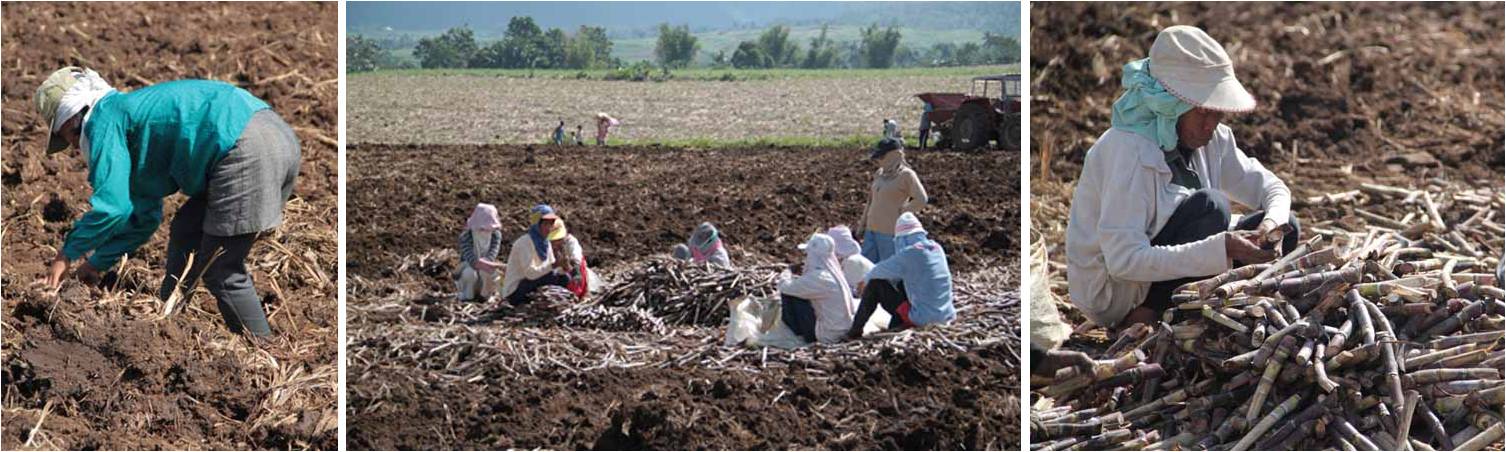
I passed by a group of women in one of the newly plowed fields. Some were sorting planting materials, while some were distributing planting materials between rows, and the rest were on their hands and knees, planting cane. It was a little past 10 in the morning, and the sun was high up. Most of the women looked up as I passed, so I called out a ‘good morning’ and waved a friendly hand. They wave back. They were wearing long-sleeved shirts, skirts or shorts over trousers, and head protection consisting of a t-shirt draped over the head tied securely around the forehead by a towel or another piece of t-shirt, or hats.

I approached one sorting party and chatted with them. They’ve been on the field since dawn, and they’ll be there until the afternoon, when they finished this parcel. It was only past 10 in the morning, but the sun is scorching, and there was no cover to be had. It must’ve been around about 32 °C, and it will only get hotter as the day progresses. These women will get burned. And they do, every day, working in these cane fields since harvest started in October. But at least there is work. Come off harvest starting June, and while cane is growing, the cane fields of Negros are usually empty, save for some maintenance activities.

I bid them goodbye, and turned towards Transect 3. The continued their work under the scorching heat. All in a day’s work.


Saturday, November 20, 2010

A different ballgame

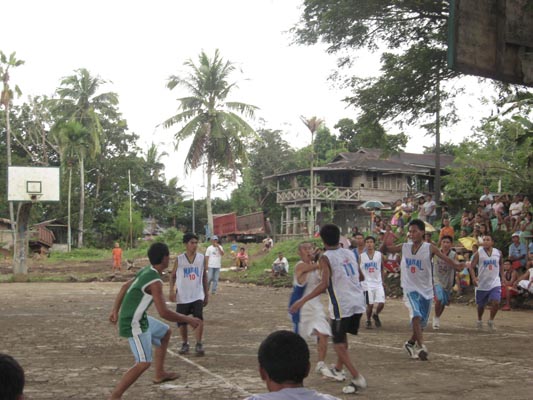
Basketball to Filipinos is like football (soccer) to Brazilians. We just love the game. So much so that if one goes around the Philippines, you’ll find basketball courts in villages everywhere, even in the middle of the streets (the two rings are on either side of the street). Not to mention a lot of the work offices, both private and government. And, everyone watches.

As such, I thought it would be a good idea to have one of the basketball teams of the hacienda carry the name ‘Maral’ (the local name for the leopard cat). After all, everyone comes to the game, even people from other haciendas. This annual basketball league games start from the second week of November and lasts until before Christmas; quite a bit of exposure for the leopard cat, and an unconventional one at that.

So I went to my first game earlier today. The team’s jerseys were just hot off the tailoring shop, and I was eager to see how they’d fare. More importantly, I was anxious to see how the audience will receive them. This is already their second game, and they had changed their name from ‘Wildcats’ to ‘Maral’.

The game has already started by the time we got there. My team is on its element. And the people were cheering: "Maral! Maral!" I was fervently hoping that subconsciously, their cheers for the cat that frequents their cane fields will penetrate them, and that consciously, they will be our allies in conservation.

Tuesday, November 2, 2010

The doldol tree


I heard this story when I was still working with FFI-PBCP doing an ethnobiological survey of the distribution and conservation status of the leopard cat. I was talking to the women in an upland barangay in Antique, and they said, “You know the doldol [Ceiba pentandra] means a great deal to us.” “How so?,” I wondered out loudly to them. They smiled, “Because when the doldol dehisces, we know our men will be coming home soon.”

The sakadas arrived in the hacienda the day before. There are about 70 of them; all of them from Antique. As I stood before them early this morning, discussing the project, I peered through their faces. Some are young, some are about my age, and some are older. In the next seven months, these men will be harvesting the cane. They will be seeing our live traps, and our hair snares. Chances are, they will be uncovering kitten, encountering adult cats. We need to know if they do. I also asked them to let the cats be. I explained why. They seem to understand. Some were nodding their heads. Most were just listening.

We shall see. I am hopeful though.

Thursday, July 22, 2010

Hacienda

Hacienda Dos Marias in Barangay Araal, La Carlota City in the province of Negros Occidental, Philippinesdrawn from map by Dez Fernandez